

Understanding Climate Impacts on PNW Water: Connecting climate change to local water realities Tuesday, July…
Washington Water Watch – Spring 2026
Washington Water Watch – Spring 2026
In this Issue
- Message from Chris Wilke, Executive Director
- GiveBIG for Washington Waters!
- Ralph Johnson Award Nominations Open
- Skagit Dam Relicensing and Mitigation
- Statewide Drought Declaration
- Legislative Wrap Up
- Policy Update
- Water and Climate News
Message from Executive Director Chris Wilke
Dear Friends and Supporters,
Thank you for your support, time, and inspiration as we navigate the renewal of another beautiful springtime in the PNW. This comes against the backdrop of another whirlwind legislative session, a new statewide drought declaration, and ongoing federal deregulation — and yet we can pause to appreciate the return of daylight, birdsong, and the knowledge that a fresh cohort of juvenile salmon are silently beginning their journeys to the sea.
Water is life. At CELP, we believe clean, accessible, and equitably managed water is not a luxury — it is essential for nature and people alike. This is what we’ve been fighting for across our region for three decades. April 2026 officially marks our 30th year as an environmental protection charity! Thank YOU for making this possible!
Over the past few months, we’ve stood up to federal deregulation of wetlands and climate policy, and pushed for stronger watershed planning to curb permit-exempt wells and their impacts on stream flow. We’ve supported tribal nations in holding the line for water resource protection in proposed data center legislation, and we successfully fought back a bill that would have made it easier to swap critical aquifer recharge areas without first assuring true groundwater protection. We’re also deep in the weeds on a new statewide permitting process for altering wetlands and waterways, and we provided a critical review of the ill-conceived Chehalis River dam proposal.
One word for this work: wonky. We are often deep in the details — where small differences in language or numbers, if embedded in policy, can have outsized impacts on the health of our waters. Parts-per-million, peak seasonal stream temperatures, cubic feet-per-second: these details matter.
None of this happens without you. Your support enables us to put these details where they’re needed most, and your engagement amplifies our voice for water and climate protection in the halls of government and the court of public opinion.
Water is finite. Demand is growing. And climate change is intensifying pressure on every watershed we work to protect. The work continues.
Thank you for being part of this community of action!
With gratitude,
Chris Wilke, Executive Director
GiveBIG is May 5!
Match Available – Early giving is ALREADY OPEN!
CELP has secured matching funds from our Board of Directors, matching each gift 1:1, up to $2000.
Please consider a gift in support of our water and climate protection work as we move forward in this pivotal year.
All gifts will be matched up to $2000, prior to 11:59pm May 5.
Ralph Johnson Water Hero Nominations open!
Know of an amazing someone with a remarkable legacy of protecting Washington Waters? We’d love to consider them for the award!
Please contact Chris Wilke before May 31 at cwilke@celp.org to make your nomination.
Here is a list of past winners of the Award
Special story:
Perseverance and Compromise: The Fight for Salmon, Culture, and a New Relationship with the Skagit River
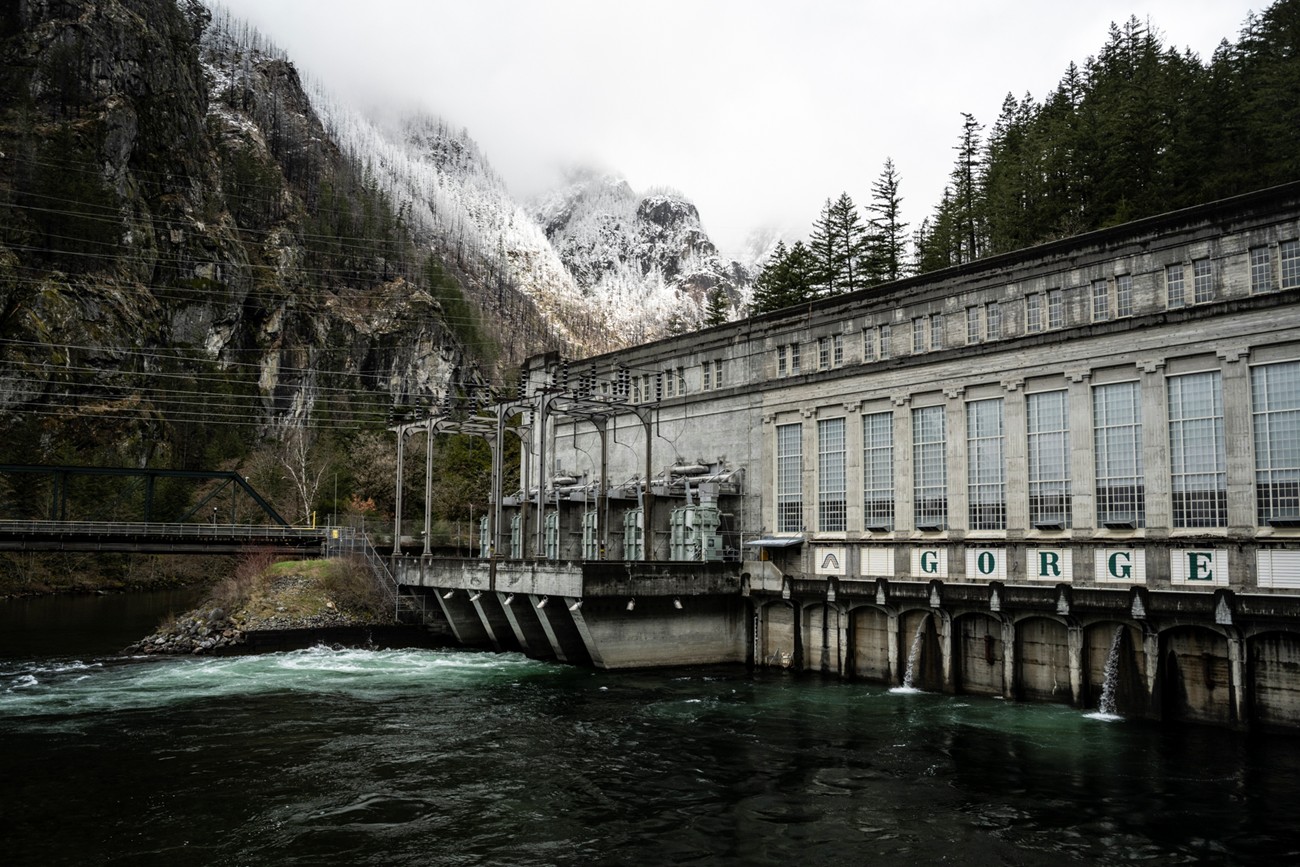
Gorge Dam is the lowest of the three dams on the Skagit River, and the first impassable obstacle for salmon. Photo: Christian Murillo
The Skagit River has been dammed for over 100 years. Construction of Gorge Dam began in 1921 and delivered electricity to the city of Seattle by 1924. For the tribes along the Skagit River, this was a desecration of their culture and a violation of the rights. Now, a landmark $3.8 billion package has been made in a settlement between the city of Seattle and the Skagit Basin tribes, acknowledging the cultural and ecological damages of the dams and using a portion of those funds to restore cultural flows, habitat, and salmon in the Skagit River.
Photographer Christian Murillo spoke with Scott Schuyler from the Upper Skagit Indian Tribe and shared a story on this important settlement. (Both are CELP Board members)
2026 Washington State Legislative Update- a Whirlwind!
Being an off-year for the biennial budget, 2026 was another fast-paced “short session” of the Washington Legislature. CELP’s team worked alongside our volunteers and partners to fight clean and flowing waters. Here’s a snapshot of our priorities, activities, and where things stood at the end of session.
Working together for water protection – 2026 Clean & Abundant Waters Lobby Day!
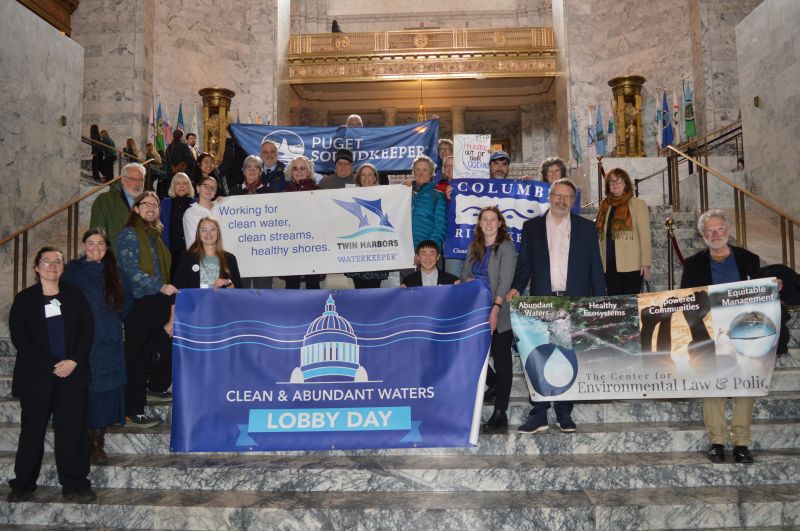
CELP was proud to collaborate with our Waterkeeper partners across Washington state this session, including our friends at Puget Soundkeeper, Spokane Riverkeeper, Columbia Riverkeeper and Twin Harbors Waterkeeper. On February 19th our organizations, along with members and community volunteers, revived our Clean and Abundant Waters Lobby Day tradition. Our team members attended over 25 meetings with legislators and staff, promoting or opposing bills in order to better protect our state’s waters. Thanks to all the staff and volunteers from the organizations that participated. We look forward to seeing you again next year!
The 2026 Lobby Day Team inside the Capitol Rotunda
Protecting critical aquifer recharge areas and curbing proliferation of permit-exempt well connections.
Two of our biggest successes this session involved constraints on development that could otherwise dewater aquifers and impact stream flows. HB6016 would have made it easier to swap lands within critical aquifer recharge areas into urban growth areas, exposing them to development pressure without first calculating their importance for aquifer recharge or impact on stream flow. CELP strongly opposed this bill with oral and written testimony, and we were pleased it did not advance.
Another bill, HB1345, which we supported, passed the legislature and was officially signed into law by the Governor on March 27. This new law goes into effect on June 11 and will put reasonable constraints on new auxiliary dwelling units (ADUs) on properties in rural areas, limiting new well connections, requiring documentation and metering, and thus protecting ground water and stream flow from depletion. We view these as sensible limits that don’t impinge on property owners.
Data Centers and Water: A Growing Concern
CELP was pleased to see new legislation (HB2515) that would provide transparency and accountability for data centers as they continue to proliferate across our region. Unfortunately, the major water-protection portions of the bill were stripped before it passed the House. CELP testified in solidarity with Eastern Washington Tribes as they successfully pushed to reinsert this important language back in on the Senate side. However, ultimately it appeared to be “too much” to consider in the final days of this short session and the bill did not advance into law. These issues are now fortunately preserved for future sessions, and we plan to work on this in the interim session to see eventual passage of these important protections. Clean and flowing waters cannot be a casualty of the tech boom.
Plastic Pollution, Toxic Tires, and More
CELP and our partners supported several bills that would potentially have significant water quality benefits: including a Bottles and Cans Recycling Refund Act (HB1607), updates to the plastic bag ban (HB2233), an Environmental Crimes Bill (SB 5360) and legislation requiring ships to use lower-sulfur fuels to reduce pollution entering state waters (HB1652). Another bill would have phased out 6PPD, a tire chemical toxic to salmon (HB2421/SB6119). While there was some support for these bills at the committee-level and/or passing the house of origin, they ultimately did not advance, and we look forward to revisiting them for the next session.
The Work Continues…
In a short session everything moves fast, and we do everything we can to stay on top of developments. Next year will be a full session and we hope to increase opportunities for your participation to help pass important bills on the issues that matter most to Washington’s waters and communities. Thank you for standing with us on behalf of Washington waters and climate!
Washington’s Drought Crisis:
Climate change is hitting home.
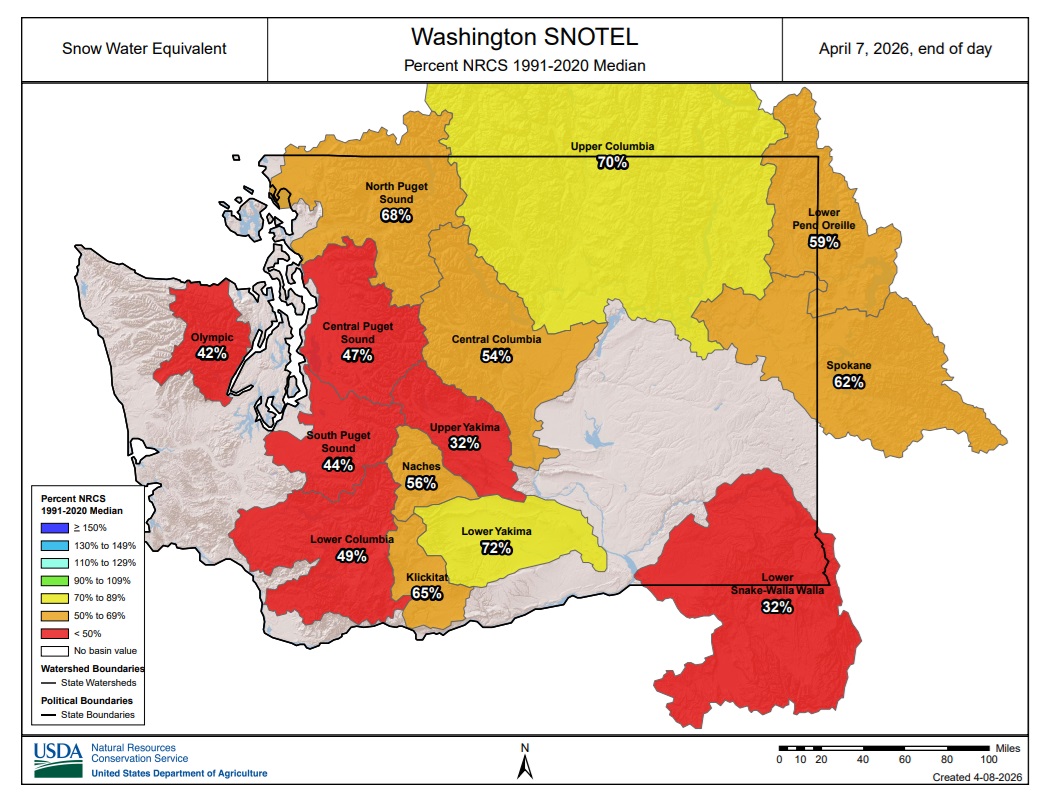
On April 8, the Washington Department of Ecology issued a statewide emergency drought declaration. Driven by low snowpack, it was the fourth consecutive year of a drought declaration in the state. Washington entered April with roughly half of its normal snowpack, and many river basins are sitting below 50% of normal. While we received 104% of normal precipitation this past winter, record early winter temperatures meant too much falling as rain rather than snow, which left mountains without the necessary snowpack storage that sustains water supplies and streamflows through summer and early fall. Read the press release here.
Washington’s fourth consecutive drought declaration is an unfortunate record under the current drought framework established in 1989. Regrettably, this situation is likely to become more common moving forward. It is consistent with long-term trends driven by climate change, tracking with or ahead of predictions by the UW Climate Impacts Group.
The statewide declaration underscores that consequences are expected to be widespread. Farmers may need to reduce irrigation or leave some fields unplanted, junior water rights holders will likely face significant curtailment, and fish populations face significant threats from low streamflows and rising water temperatures. In addition, many are keenly aware that reduced snowpack heightens wildfire risk throughout much of the state. Development of long-term water resiliency plans will likely need additional attention, acknowledging that snow droughts are becoming the new normal.
At CELP, we believe that statewide drought response must include strong legal protections for instream flows and tribal water rights, meaningful investment in water conservation, and policies that center ecological health, adequate streamflows and community resilience. We also need to take a hard look at any proposed new water demands such as with data centers, poorly managed development and/or increased hydropower generation. We’ll keep you informed as this situation develops.
Policy Update:
Current policy priorities and recent actions
Ensuring strong statewide rules for alterations to waterways (state-level “dredge and fill” permitting): CELP is helping to build a new coalition, Protect Our Washington Waters (POW), which is providing guidance to Ecology tackle this issue and bring strong state-level protections against the backdrop of declining federal protection for wetlands and transitional streams. More to come later this year including grassroots opportunities.
Chehalis River Dam Opposition CELP submitted detailed comments on the Draft Environmental Impact Statement in February 2026. Thanks to our supporters for taking action!
Defending the Clean Water Act CELP submitted comments on EPA’s draft revision of “Waters of the US” which would drastically reduce coverage of the Clean Water Act – especially for wetlands and transitional streams. Submitted January 2026. Thanks to our supporters for taking action!
Strengthening protections limiting new water withdrawals CELP submitted comments on Department of Ecology’s draft rule for five Western Washington Watersheds to better regulate development policies allowing permit-exempt wells.
GiveBIG is live! DONATE NOW to Protect Water before May5:
https://www.wagives.org/organization/center-for-environmental-law-policy
Donations are always open at:
Other Water and Climate News:
- Legal Victory for Columbia River Salmon: Court orders more frequent “spill” from dams on the Columbia and Lower Snake rivers and blocks proposal to increase reservoir pool elevations, helping out-migrating salmon survival
- New Water Treatment system for rural town is expected to reduce pollution levels
- Clean Water Victory: Darigold to pay $2 Million to Yakama Nation in a settlement with Columbia Riverkeeper over pollution in the Yakima Basin
- Widespread Drought Impacts: Our current drought is much wider than just Washington state or the PNW, now covering 60% of the nation
- Climate Leadership: The First Conference on Transitioning Away from Fossil Fuels is underway in Santa Marta, Colombia
- Slowing the Fossil Fuel Buildout: Hearings Examiner rejects LNG facility in Whatcom County
Contact Us!
 |
Related Posts
